What is the I Ching? When six bamboo sticks are arranged in a row, why does it reflect your current situation?/易經是什麼 · 六根竹簽排一排,為什麼能照出你現在的處境
- WenLaoshi
- 7月20日
- 讀畢需時 4 分鐘

What Is I-Ching? Six Lines in a Row—How Can They Scan Your Current Situation
A programmer client asked me last year: "When Leibniz invented binary, did he reference I-Ching?"
I said yes.
He paused. "You had binary 3,000 years ago?"
"Not exactly. Ancients found the most minimal way to describe change. It happens to look a lot like your binary."
He was silent for 10 seconds. Then: "So our entire modern computer is related to a fortune-telling book?"
I corrected him: "Not fortune-telling. Book of Changes."
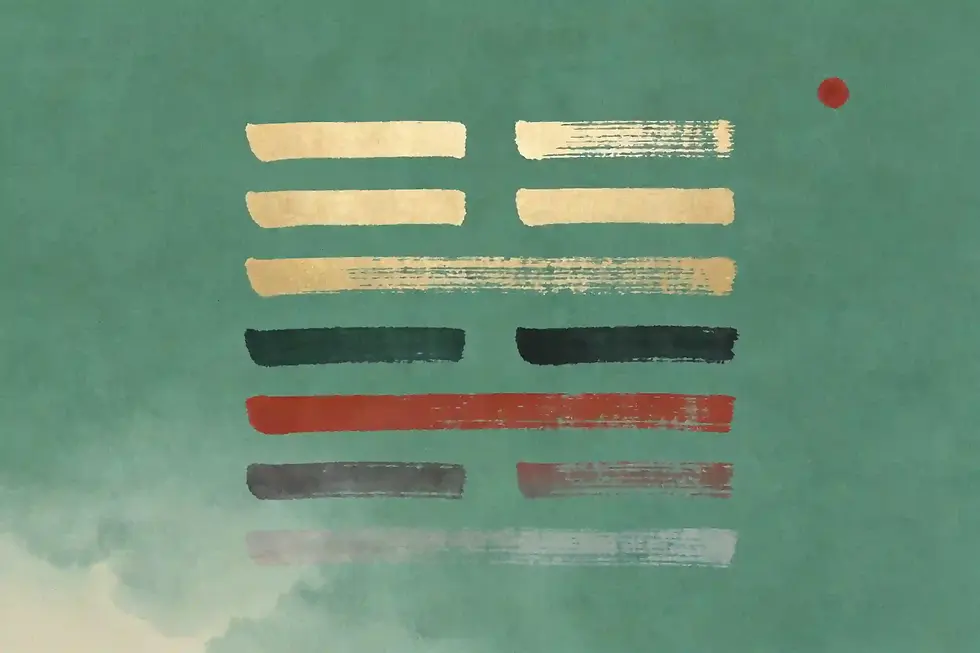
Most people see six broken or solid lines and think: what's the code?
It looks like one. It isn't.
Hexagrams are a six-layer situation scanner.
Each line has only two states—broken (yin) or solid (yang). Six layers stacked, 2 to the 6th power = exactly 64 combinations.
64 combinations = 64 basic situation types.
Think of it as a 64-square board. Each square represents a kind of situation you're experiencing. Not prophecy. Classification.
(A confession) When I teach students, the most common mistake is trying to "translate" hexagrams literally. Seeing Qian and thinking "dragon." Qian isn't a dragon. Qian is "all conditions are rising, move with momentum."
Strip the imagery. The structure is clear.
Six lines from bottom to top represent a thing's timeline from emergence to completion. Bottom line = just sprouted. Top line = reached the end.
Your position determines whether you should move. That's the entire secret of hexagrams. A six-layer position detector.
Weather forecasting works on nearly identical logic. Meteorologists don't say "it will definitely rain." They say: current atmospheric state matches a model, and historically that model has 70% rain probability.
Hexagrams do the same thing—your current situation matches a model, historically the tendency is X.
Different tools, same logic: classify complex reality into finite models, use historical probability to assist judgment.
You trust weather forecasts not for their accuracy, but for the classification-plus-probability methodology behind them.
Hexagrams use the same method.
Next time someone asks "what are hexagrams," try: six lines, 64 situations, which square are you in.
That simple. Simple enough to doubt: really, that's it?
Yes. But unbroken for 3,000 years—that part isn't simple.
Book a decision consultation—40 minutes to find your square.
————————————————————————————————————————————————————
開場 · 一個學電腦的朋友問我:你們那個二進位,誰先搞的
去年一個做程式員的客戶來找我,聊到一半忽然問:
「聞老師,萊布尼茨發明二進位的時候,是不是參考了你們的易經?」
我說:「是。」
他愣了一下:「你們 3000 年前就在搞二進位了?」
我說:「不算搞。是古人發現了一種描述事物變化最精簡的方式,跟你們後來發明的二進位,長得很像。」
他沉默了大概 10 秒。然後說了句讓我記到現在的話:
「所以我們整個現代電腦的底子,跟一本算命書是親戚?」
我糾正他:「不是算命書。是變化之書。」
反轉 · 卦象不是密碼,是**處境掃描器**
多數人看到六根斷斷續續的橫線,第一反應是:這是什麼暗號?
看起來是密碼。其實不是。
卦象的本質是一個六層的處境描述器。
每一根線(爻)只有兩種狀態——斷(陰)和連(陽)。六層疊起來,2 的 6 次方,剛好 64 種組合。
64 種組合,對應 64 種處境的基本型。
你可以把它理解成一張 64 格的棋盤。每格代表一種"你正在經歷的局面"。不是預言,是分類。
(較真式自嘲)我帶學生的時候發現,大家最容易犯的錯誤是——試圖"翻譯"卦象。比如看到乾卦就覺得是"龍"、看到坤卦就覺得是"大地"。其實這些意象只是古人給每種處境找的類比標籤。乾不是一條龍,乾是"所有條件都在往上走、你順勢而上"的那種局面。
把象拆掉,格局就清楚了。
六根線從下到上,代表的是一件事從萌芽到完成的時間軸。
最底下那根(初爻)= 事情剛冒頭。
最上面那根(上爻)= 事情走到頭了。
你在哪個位置,決定了你該不該動。
這就是卦象的全部秘密。沒有密碼,沒有暗號。一個六層的位置探測器。
跨界 · 氣象局也幹過同一件事
天氣預報的原理,跟卦象的邏輯結構幾乎一樣。
氣象局不會告訴你「明天一定下雨」。它告訴你的是:當前大氣狀態屬於某個模型,這個模型歷史上 70% 的概率會下雨。
卦象幹的也是這件事——當前處境屬於某個模型,這個模型歷史上傾向於什麼走向。
區別是氣象局用的是衛星數據和超級電腦,古人用的是六根竹簽。
工具天差地別。底層邏輯一模一樣:把複雜局勢歸類到有限模型,用歷史概率輔助判斷。
現代人覺得天氣預報靠譜、卦象不靠譜——其實你信的不是天氣預報的"準確性",你信的是它背後那套歸類+概率的方法論。
卦象用的,恰好也是這套。
收束 · 卦象不神秘,它只是很老
下次有人問你「易經卦像是什麼」。
你可以試一句:六根線,64 種局面,你在哪一格。
就這麼簡單。簡單到你會懷疑:就這?
對,就這。
但 3000 年沒斷過,這件事本身不簡單。
我做決策諮詢,用的就是這 64 格模型幫你定位:你現在在哪個格子裏,那個格子歷史上怎麼走。
預約一次決策諮詢——40 分鐘,幫你找到你當前在哪一格。


留言