Three Thousand Years Ahead of the Risk Report/三千年前寫好的風控手冊

In September 2008, Lehman Brothers collapsed. Before that day, the brightest minds on Wall Street had used mathematical models to prove that the probability of these debt defaults was near zero. The models said everything was fine. Until it wasn't.
Around three thousand years earlier, someone wrote at the top of the Qian hexagram: "The dragon overreaches. There will be regret."
Strip away the mythology and you get a clean logical statement: anything pushed to its extreme will reverse. Apply this to credit expansion, and it maps perfectly onto what happened.
But here's the question: if belief is the price of admission to the I Ching, are non-believers simply locked out?
Follow that logic one step further. If you insist every decision tool must be empirically validated before use, you shouldn't invest either—because you can't prove the market won't crash tomorrow. You shouldn't hire anyone—because you can't prove they won't fail you at the critical moment. In fact, you shouldn't leave your house.
All decisions are made with incomplete information. The real question isn't "do you believe in this tool." It's: does the framework this tool provides produce better decisions than guessing?
The power of "the dragon overreaches" isn't mystical accuracy. It's a pure logical proposition: any system that expands beyond its support structure will likely collapse. Anyone who's run a business for more than a year has seen this script play out.
Think of it like jazz improvisation. Amateurs assume improvisation means playing whatever you want. In reality, jazz musicians improvise within strict chord progressions—the harmonic structure, rhythm patterns, and modal constraints define the space where creativity lives. Without chord progressions, improvisation isn't jazz. It's noise.
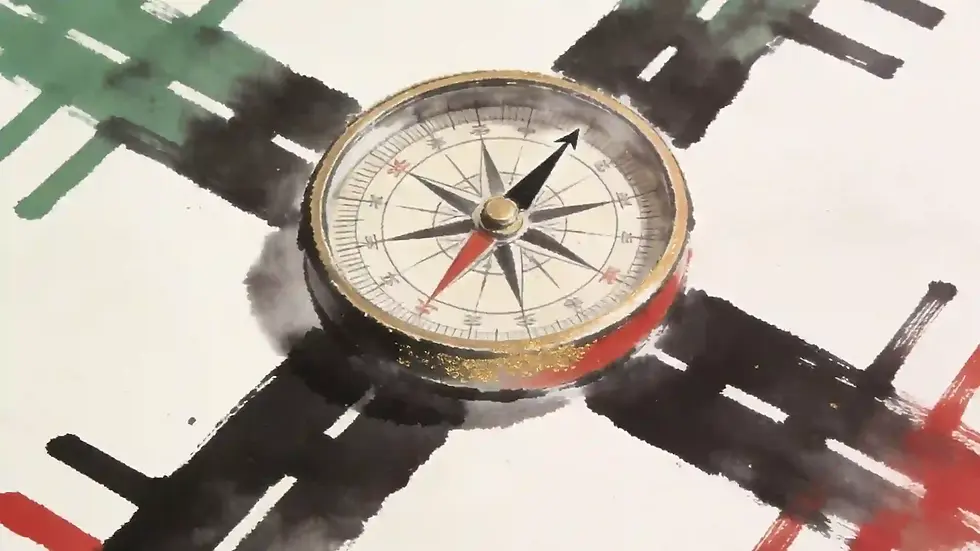
The sixty-four hexagrams offer a similar constraint framework. Each one describes the structure of a situation: which forces are advancing, which are retreating, where the critical turning points lie. The Qian hexagram, read from bottom to top, isn't fortune-telling—it's a complete development-stage model: latent phase, accumulation, probing, breakthrough, zenith, decline. Whether you're starting a company, expanding, or contracting, knowing which stage you're in helps you calibrate.
Belief doesn't affect utility. A musician doesn't need to believe chord progressions are cosmic truth to play good music. A decision-maker doesn't need to believe hexagram texts are divine revelation to benefit from them. You just need to be willing to look—then use your own judgment to make your own decisions.
If your decision system hasn't yet incorporated the variable of "when to pull back," it might be worth talking to someone who specializes in decision frameworks. Not necessarily about the I Ching. About the decisions themselves.
—————————————————————————————————————————
2008年9月,雷曼兄弟倒下了。在它之前,整個華爾街最聰明的人用數學模型證明了:這些債務違約的概率幾乎為零。模型顯示一切正常。直到一切都不正常了。
有意思的是,大約三千年前,有個人在幹卦最頂部寫了一句話:"亢龍有悔。"
翻譯過來就是:飛得太高,必有悔恨。
你不需要信這句話是神諭。它就是一個邏輯判斷——任何事物發展到極端,下一步就是下坡路。你把這條規律應用到信貸擴張上,和雷曼的結局完全吻合。
但問題來了:如果"信"是使用易經的前提,那不信的人是不是就沒資格碰它?
順著這個邏輯再走一步。如果你認為每個決策工具都必須經過實證檢驗才能使用,那你也不應該投資——因為你沒法證明明天的股市不會崩盤。你也不應該招人——因為你沒法證明這個人不會在關鍵時刻掉鏈子。事實上,你連出門都不應
該——因為你沒法證明自己不會被花盆砸到。
所有決策都是在資訊不完整的情況下做出的。
問題從來不是"你信不信這個工具"。問題是:這個工具提供的決策框架,是否比拍腦袋強?
"亢龍有悔"的厲害之處不在於它"算得准"。在於它是一個純粹的邏輯命題:任何系統過度擴張到超出支撐能力,崩潰就是大概率事件。任何幹過幾年實業的人都見過這種劇本。但當有人用四千年前的語言把它說出來,大家反而覺得這是迷信。
這和爵士樂手即興演奏一個道理。
外行以為即興就是隨便彈。其實不是。爵士樂手在嚴格的和絃進行框架裏即興——和絃走向、節奏型、調式,這些約束條件劃定了自由的空間。沒有和絃進行的即興,那不叫爵士,叫噪音。
六十四卦提供的是類似的約束框架。每一卦描述一種處境的結構:哪些力量在推進,哪些在退潮,哪個節點是關鍵轉折。比如幹卦從頭到尾不是"算命",而是一個完整的發展階段模型:潛藏期、積累期、試探期、躍升期、鼎盛期、衰退期。你創業、擴張、還是收縮,大概處於哪個階段,自己心裏有數就行。
信不信不影響使用。
音樂家不需要相信和絃進行是宇宙真理才能彈出好音樂。決策者也不需要相信卦辭是神啟才能從中受益。你需要的只是願意翻開來看一眼——然後用你自己的判斷做你自己的決定。
如果你的決策系統裏還沒有納入"什麼時候該收手"這個變數,也許值得找專業的人聊聊。不一定是聊易經。聊的是決策本身。


留言